
Selected reviews
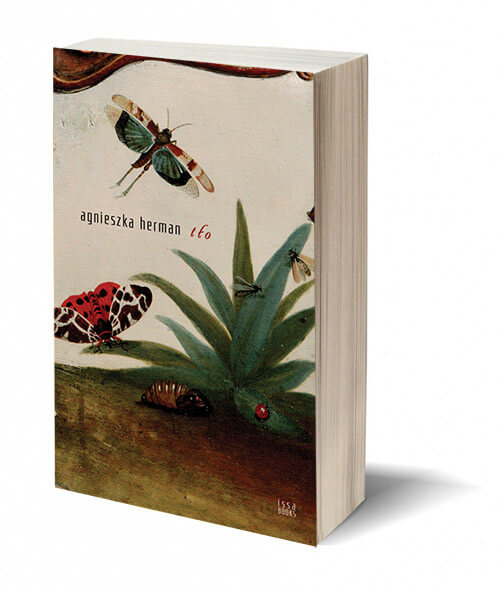
“TŁO” / “Background” (publ. 2019)
How does she do it? Quite simply: she takes a detail from the background and enlarges it. With a single stroke of the pen. The act of choosing is always a creative act – the scale changes, tension arises. At times to the point of pain. As in haiku, a minimum of words gives full insight into the essence of things. It is hard to believe that the drama of life, the drama of death, fit entirely into these extraordinarily delicate and sparing poems.
And yet she manages it – Agnieszka Herman has written a cycle of minimalist poems that grow with each successive reading. Is this not precisely what true poetry is about?
Anna Janko
(…) The parallelism of the opening quasi-titles lends the whole collection a litany-like character. That “let there be” (“let there be” in the plural) evokes the phrase spoken by the Creator: “Let there be…”. The poems of Agnieszka Herman thus contain an echo of the Words whose utterance drew the world out of nothingness. If the poet’s word is to have a redeeming character, it must follow the traces of the Word spoken by the One Who Is. True poetry is participation in the creative and redemptive gesture of God.
Janusz Nowak, “Z popiołu i słońca my wszyscy” (“From Ash and Sun We All Are”), TOPOS
“Tło” by Agnieszka Herman is not a sentimental tale of human feeling, but a kaleidoscope of portraits of human sensitivity. Already in the first poem opening the collection – “let the background be a bed with a wooden headboard” – an important illustration of a turn in contemporary poetry appears. Here, emotions matter more than lofty aims. This is why the mourning prayer flowing from “the rosary beads passed between the fingers” helps to form a mythical bridge between the human being and God. Herman treads on boggy ground, touching a person’s most tender places while at the same time calling upon their imagination.
Anna Łozowska-Patynowska, “Jak sportretować uczucie?” (“How to Portray a Feeling?”), LATARNIA MORSKA
“Tło” is one of the best books of poetry this year. Superbly typeset, with an interesting idea and consistent execution. Extraordinarily moving, too, are the photographs of small things – everyday objects or fragments of scenery well known to us. Here image works wonderfully together with word, underscoring the singular atmosphere of these lyrical tales.
Kinga Młynarska, PRZECZYTANE, NAPISANE
A conceptual, remarkably coherent and consistent volume (…) The human eye registers, in the background, in shadow, in fog, blurred images; the farther from the object, the worse we see them. Agnieszka Herman seems to move with her lens not away from that background but toward it. And she draws out the strange things that wished to hide in the background.
MAGAZYN LITERACKI KSIĄŻKI
The book is a synthesis of refined graphic design and miniature poems. (…) The title backgrounds shelter all things dramatic and joyful, coming together into a tale of human fate.
Janusz Nowak, GOŚĆ NIEDZIELNY
The poems of Agnieszka Herman from the collection “Tło” are, as it were, timeless, halted for eternity. Our life consists of flashes of moments that we later recall and try to give meaning to. (…) The association arises that the individual poems are, as it were, beads of a poetic rosary, rungs of a rapture that leads us to a literary heaven.
Zdzisław Antolski
Our mirrors hang not on the walls, but within us.
Leszek Żuliński, GAZETA KULTURALNA
EARLIER VOLUMES
A very interesting poetic personality. It seems we are dealing with a traditional, orderly poetics, set within a certain historical – and aesthetic – context; but soon it turns out that from time to time unpredictable things surface here, as if the author wished to surprise herself on her journey toward the Word.
Krzysztof Karasek
I am reading Agnieszka Herman’s volume titled “Zapisane światłem” (“Written in Light”) and savouring it. (…) I greatly enjoyed the second part of Agnieszka Herman’s volume – the songs. It has been a long time since I read songs, and I am glad to see that they are deft and immensely personal, and perhaps often wiser than those galaxies.
Agnieszka Osiecka, EXLIBRIS
The editor Piotr Adamczewski took me to task recently for practising crypto-advertising in my columns, which is improper and ought not to have any place. Well, Piotr Adamczewski is mistaken – I engage in no crypto-advertising. It is far worse. I advertise in the most direct and unbridled manner: Basia, white wine, friends and certain non-friends (who in Poland would still remember Zbigniew Brzeziński were it not for my mentions of him), the poetry of the two Agnieszkas, Herman and Osiecka, the songs of Andrzej Rosiewicz, Kuba Sienkiewicz, Ania Szałapak (…).
Ludwik Stomma, POLITYKA
The volume “Zapisane światłem”, containing 23 poems and 4 songs, I rate very highly. These works are marked by formal artistry, clarity, lucidity and precision of the word, as well as a skilful organisation of the poem. Agnieszka Herman knows how to make use of various poetic forms: the confessional, the discursive, the antithetical, the prayer-like, the landscape, and the persona lyric. Her poems “written in light” resemble X-ray plates on which the image of the world and an inner poetic landscape have been fixed. Discursive poems predominate in the volume, into which the poet weaves metaphors and images, doing so naturally and freely.
Jan Witan, WIK
A rich imagination, precision of the word, communicativeness of expression – these are the strengths of her poetry.
Wacław Wiercioch, AKANT
This poetry rests on a lyrical diction and an intimate one. It turns out, however, that these need not “over-sweeten” the poem. For the simple reason that the aestheticisation of images does not necessarily banalise the Sense. Herman walks through her own existential back-alleys, and here she has much to say. Yet strange is this tale. Wholly extracted from the din of everyday life, from the urban clamour, from daily drudgery and mundane routine. Here I heard, unceasingly, the spleen of solitude and quiet steps set down not so much on the earth as in an introverted aura.
Leszek Żuliński, LATARNIA MORSKA
“Jesienią najtrudniej iść środkiem dnia” (“In Autumn It Is Hardest to Walk Through the Middle of the Day”) is THAT poetry – these are exactly the books one waits for; one reads hundreds of poems in the hope of one day coming upon those that move us exceptionally. Agnieszka Herman is able to satisfy even the most demanding reader.
Kinga Młynarska, PRZECZYTANE, NAPISANE
Agnieszka Herman’s poems enchant with their mood, seduce and intoxicate in a feminine way, invite the reader on a journey. Indeed, the reader feels drawn into this surreal world of late autumn. Into a long, not easy journey to the sources of solitude. And yet it is a beautiful wandering – through painterly landscapes, autumnal melancholies, fascinations with mysticism and beauty, that is, into the land of poetry.
Zdzisław Antolski